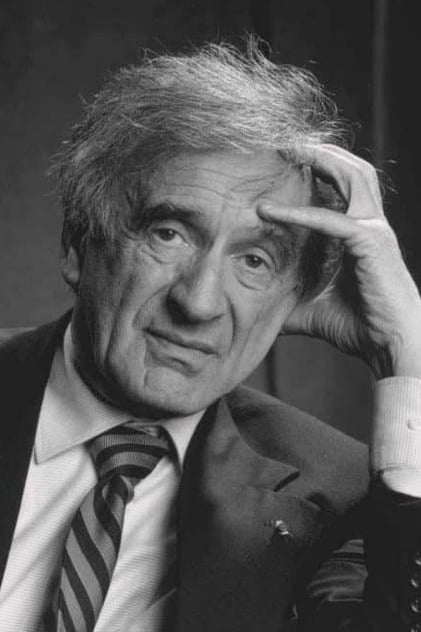
Elie Wiesel
Personal information
- Known for
- Сценарий
- Known credits
- 21
- Gender
- Мужской
- Born
- 30 сентября 1928 г.
- Died
- 2 июля 2016 г.
- Place of birth
- Sighet, Transylvania, Kingdom of Romania [now Sighetu Marmatiei, Maramures, Romania]
- Also known as
- Eliezer Wiesel
Biography
Elie Wiesel (born Eliezer Wiesel, Yiddish: אליעזר װיזעל Eliezer Vizel; September 30, 1928 – July 2, 2016) was a Romanian-born American writer, professor, political activist, Nobel laureate, and Holocaust survivor. He authored 57 books, written mostly in French and English, including Night, a work based on his experiences as a Jewish prisoner in the Auschwitz and Buchenwald concentration camps.
He was a professor of the humanities at Boston University, which created the Elie Wiesel Center for Jewish Studies in his honor. He was involved with Jewish causes and human rights causes and helped establish the United States Holocaust Memorial Museum in Washington, D.C. In his political activities, he also campaigned for victims of oppression in places like South Africa, Nicaragua, Kosovo, and Sudan. He publicly condemned the 1915 Armenian genocide and remained a strong defender of human rights during his lifetime. He was described as "the most important Jew in America" by the Los Angeles Times in 2003.
Wiesel was awarded the Nobel Peace Prize in 1986. The Norwegian Nobel Committee called him a "messenger to mankind", stating that through his struggle to come to terms with "his own personal experience of total humiliation and of the utter contempt for humanity shown in Hitler's death camps", as well as his "practical work in the cause of peace", Wiesel delivered a message "of peace, atonement, and human dignity" to humanity. The Nobel Committee also stressed that Wiesel's commitment originated in the sufferings of the Jewish people but that he expanded it to embrace all repressed peoples and races. He was a founding board member of the New York Human Rights Foundation and remained active in it throughout his life.
Elie Wiesel was born in Sighet (now Sighetu Marmației), Maramureș, in the Carpathian Mountains of Romania. His parents were Sarah Feig and Shlomo Wiesel. At home, Wiesel's family spoke Yiddish most of the time, but also German, Hungarian, and Romanian. Wiesel's mother, Sarah, was the daughter of Dodye Feig, a Vizhnitz Hasid and farmer from the nearby village of Bocskó. Dodye was active and trusted within the community.
Wiesel's father, Shlomo, instilled a strong sense of humanism in his son, encouraging him to learn Hebrew and to read literature, whereas his mother encouraged him to study the Torah. Wiesel has said his father represented reason, while his mother Sarah promoted faith. Wiesel was instructed that his genealogy traced back to Rabbi Schlomo Yitzhaki (Rashi), and was a descendant of Rabbi Yeshayahu ben Abraham Horovitz ha-Levi.
Wiesel had three siblings—older sisters Beatrice and Hilda, and younger sister Tzipora. Beatrice and Hilda survived the war, and were reunited with Wiesel at a French orphanage. They eventually emigrated to North America, with Beatrice moving to Montreal, Quebec, Canada. Tzipora, Shlomo, and Sarah did not survive the Holocaust. ...
Source: Article "Elie Wiesel" from Wikipedia in English, licensed under CC-BY-SA 3.0.
This biography is only available in English.
Popular




Filmography
Сценарий
5 titles

Актёрская работа
17 titles2024